Date:Jul 27, 2026
Content
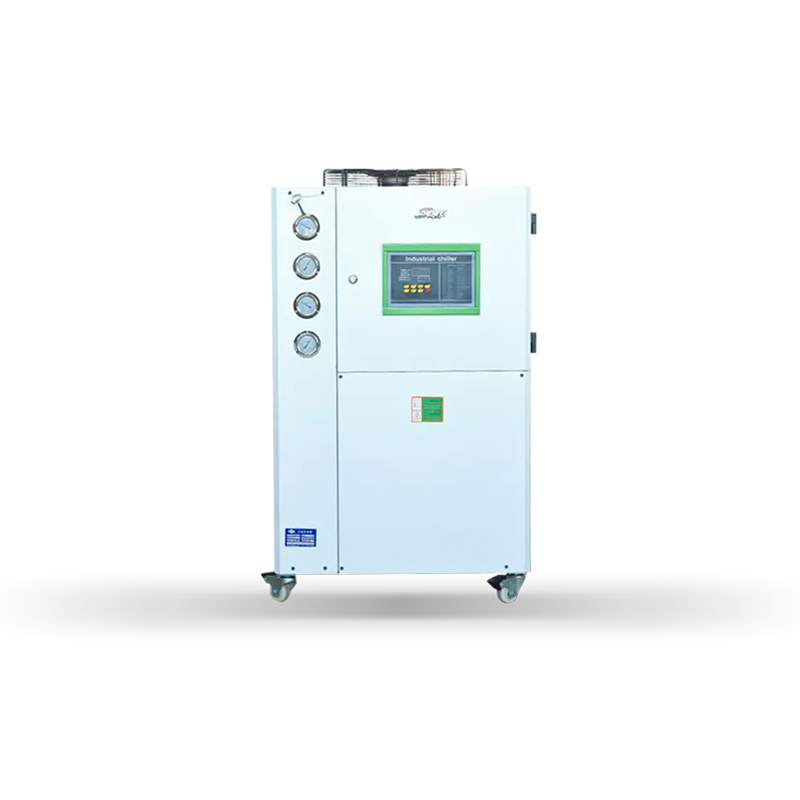
An industrial chiller removes heat from process equipment or a facility by circulating chilled liquid, typically water or a water-glycol mixture, through a refrigeration cycle that absorbs heat from the process and rejects it to the outside air or a separate water source. It is the correct equipment choice whenever a process generates heat that must be removed to maintain product quality, equipment performance, or worker safety — common examples include injection molding machines, laser cutting systems, CNC machining centers, and industrial refrigeration for food and beverage production.
For most manufacturing facilities, the correct chiller type and capacity depend on cooling load, ambient conditions, and available water resources — get these three variables right, and the chiller will run efficiently for its full service life; get them wrong, and the facility faces either inadequate cooling or excessive energy costs. A chiller undersized by even 10% to 15% relative to actual heat load can cause process temperature instability that directly affects product quality.
Nearly all industrial chillers operate on the vapor-compression refrigeration cycle, the same fundamental principle used in household air conditioners, but scaled and engineered for continuous industrial duty.
The most fundamental design decision in chiller selection is how the unit rejects heat to the environment, and this choice significantly affects efficiency, installation requirements, and operating cost.
| Factor | Air-Cooled | Water-Cooled |
|---|---|---|
| Installation complexity | Simple, outdoor placement | Requires cooling tower and water treatment |
| Energy efficiency | Lower, especially in hot climates | Higher, more stable efficiency |
| Water consumption | None | Requires makeup water for evaporation |
| Best suited for | Small to mid-size facilities, limited space | Large facilities, high cooling loads |
Water-cooled chillers generally deliver 10% to 30% better energy efficiency than air-cooled units of comparable capacity, since condensing against water is thermodynamically more efficient than condensing against ambient air, particularly in hot or humid climates. However, this efficiency gain comes with added complexity: cooling towers, water treatment systems, and ongoing water consumption that air-cooled systems avoid entirely.
The compressor is the heart of the chiller's refrigeration cycle, and different compressor technologies suit different capacity ranges and operating profiles.
Selecting the correct chiller requires evaluating several interconnected factors specific to the application and facility conditions.
Accurate cooling load calculation is the foundation of correct chiller sizing, and it should account for all significant heat sources rather than a single process alone.
| Heat Source | Consideration |
|---|---|
| Process equipment | Manufacturer's rated heat rejection or measured actual load |
| Ambient heat gain | Piping insulation quality and ambient temperature exposure |
| Future expansion | Anticipated production growth over the chiller's service life |
| Peak vs. average load | Sizing to peak demand while considering part-load efficiency |
A common industry practice is to add a 10% to 20% safety margin above the calculated peak load to account for measurement uncertainty and future capacity needs, though oversizing significantly beyond this range reduces part-load efficiency and increases unnecessary capital cost.
Industrial chillers support temperature-critical processes across a wide range of manufacturing sectors.
Injection molding, blow molding, and extrusion equipment rely on chilled water circulating through mold cooling channels to control cycle time and part dimensional stability, making chiller performance directly tied to production throughput.
CNC machining centers, laser cutting systems, and welding equipment use chillers to cool cutting fluids, laser sources, and machine spindles, protecting precision components from thermal drift that would otherwise compromise accuracy.
Process cooling for fermentation, pasteurization, and product chilling relies heavily on industrial chillers to maintain precise temperature control required for food safety and product consistency.
Reaction vessels and process equipment in pharmaceutical and chemical plants often require tightly controlled cooling to maintain product quality and ensure safe reaction conditions.
High-density server rooms and electronics assembly lines use precision chillers to remove heat generated by equipment and maintain stable operating temperatures for sensitive components.
Consistent maintenance directly protects both energy efficiency and equipment longevity, since even minor performance degradation compounds significantly over years of continuous operation. Regular condenser and evaporator coil cleaning prevents fouling that reduces heat transfer efficiency, while refrigerant charge verification ensures the system operates at its designed capacity rather than silently underperforming due to slow leaks. Water treatment programs for water-cooled systems prevent scale buildup and biological growth that can reduce condenser efficiency and lead to costly tube replacement, and routine inspection of compressor operating parameters helps catch early signs of mechanical wear before they result in unplanned downtime during critical production periods.

 Custom Zhenfei Electric Injection Molding Machine Manufacturers
Copyright © Ningbo Zhenfei Injection Molding Machine Manufacturing Co., Ltd. Rights Reserved.
Custom Zhenfei Electric Injection Molding Machine Manufacturers
Copyright © Ningbo Zhenfei Injection Molding Machine Manufacturing Co., Ltd. Rights Reserved.



 中文简体
中文简体 English
 Español
 中文简体
中文简体