Date:Sep 21, 2026
Content
Every injection molding workshop generates unwanted plastic: sprues, runners, failed parts, and purged material. An industrial plastic grinder (also called a plastic crusher or strong crusher) takes that waste and turns it into reusable regrind. The conclusion you should hold onto before you compare models is simple: a correctly sized grinder pays for itself by returning material back into the production loop, while a poorly matched one adds noise, dust, and downtime. This guide explains what the machine really does, what to look for when buying one, and how to keep it running safely.
An industrial plastic grinder is a mechanical unit that reduces plastic scraps into smaller, uniform granules. The feeding hopper accepts pieces such as sprues, runners, or rejected parts, and a rotating knife assembly cuts the material against stationary blades until it passes through a screen with a chosen hole diameter. The output is regrind that you can feed back into the injection molding machine, usually at a certain percentage mixed with virgin material.
It is helpful to distinguish between two common configurations. The first is a basic strong crusher, often placed near a press or in a central grinding room. It handles larger batch loads and requires an operator to load the hopper. The second is a pulverising automatic recycling machine, which is designed for continuous in-line operation. It receives scrap from the molding machine and returns the regrind to the process automatically. If you are deciding which direction to take, know how to choose a strong crusher first, because that determines whether you also need a separate automated recovery setup.
Do not confuse a grinder with a shredder. A shredder is usually a low-speed, high-torque machine that handles large bulky items, while a grinder runs at higher speed and produces smaller chips. For injection molding scrap, a grinder is normally the more economical choice.
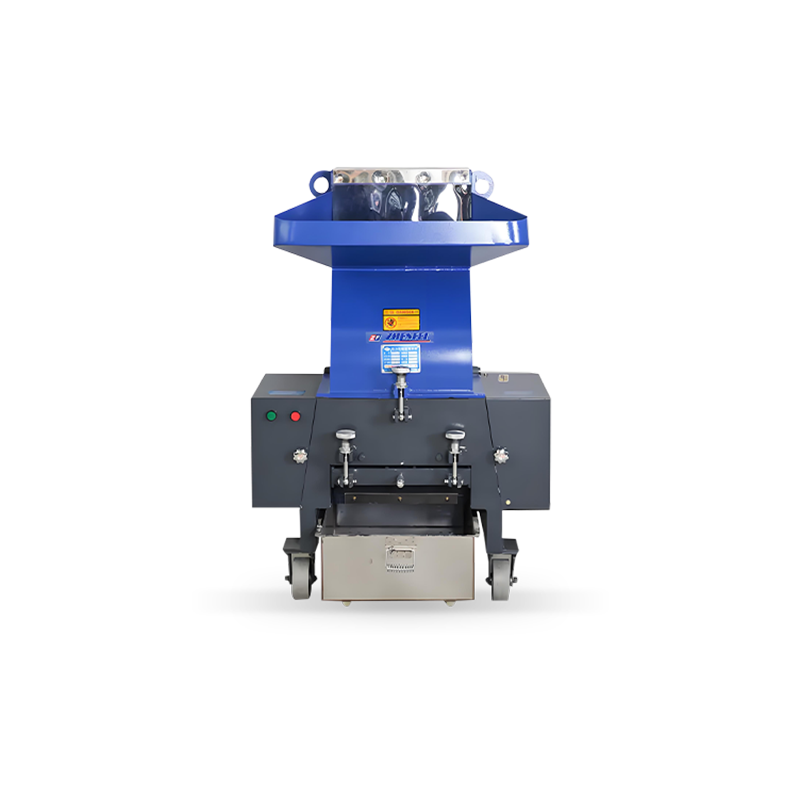
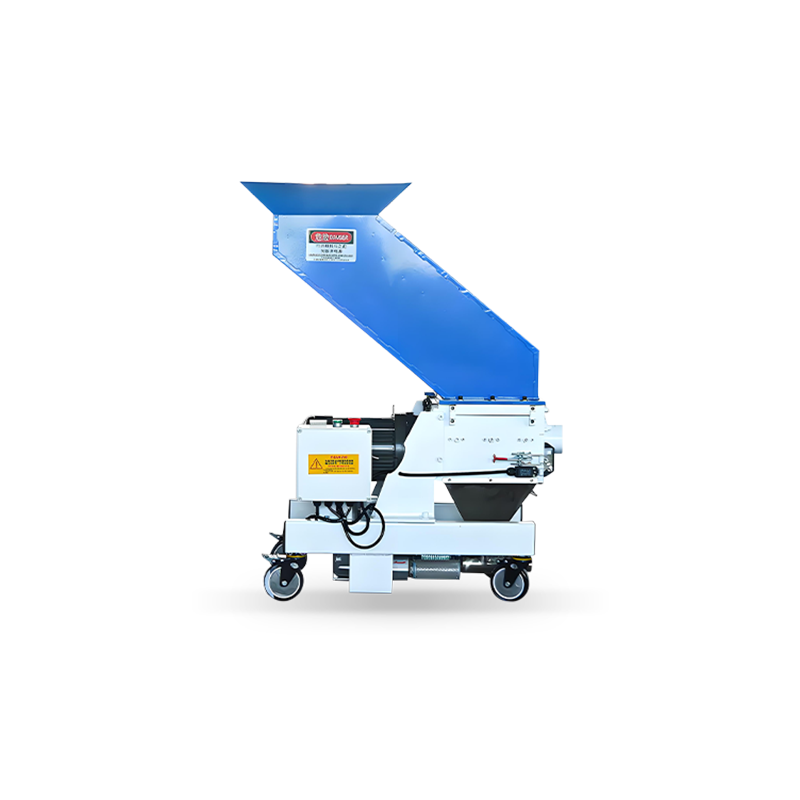
 PC Series Strong Crusher for Plastic Scrap GrindingA rugged, high-speed grinder with a steel body, soundproofing, and overload protection, designed to reduce injection molding waste into reusable chips while minimizing noise and maintenance.View Product →
The economic reason is straightforward: plastic is a raw material you already paid for. Every kilogram of regrind you recover lowers material cost. The practical reason is space. Piles of sprues and rejected parts take up floor area and create a tripping hazard. A dedicated grinder compacts that waste into a manageable volume that can be reused within the same shift.
There is also a production consistency angle. If you process regrind consistently and keep the grind size stable, the injection machine feeds more predictably. Sites that run high-volume packaging or consumer products often experience less variation by adding regrind from a reliable crusher. A machine like the PC series strong crusher is built for this kind of continuous shop-floor duty, with a steel body and blades designed for hard and soft plastics alike. Keep in mind that the grinder is not a replacement for good process discipline; it is a tool that supports a closed-loop material strategy.
Before you buy, evaluate the device against the actual scrap stream. A table of the most important parameters helps you compare offers in a structured way.
| Parameter | Why it matters |
|---|---|
| Crushing capacity (kg/h) | Match to the weight of sprues and rejects you produce per hour. Oversized machines waste energy; undersized machines clog. |
| Blade geometry and material | Hardened steel blades handle abrasive materials like glass-filled nylon. Hooked blades pull irregular parts in more reliably. |
| Screen diameter | Determines regrind particle size. Coarser screens work for larger runners; finer screens make smoother regrind. |
| Motor power and drive type | A powerful three-phase motor is safer for continuous use. Servo drives reduce idle energy consumption. |
| Noise level | Industrial grinders are loud. Ask about dB rating and consider a sound enclosure or central grinding room. |
| Conveying/feeding method | Manual hopper loading is cheaper; vacuum autoloading or automatic recycling makes the flow continuous. |
The table is not exhaustive, but these six items capture most of the risk in a buying decision.
Automatic Pulverising Recycling Machine for Plastic ReuseThis automatic pulverizer converts plastic waste into fine powder for reprocessing, helping reduce raw material costs and environmental impact, suitable for rigid materials and industrial recycling.View Product →
Different plastics behave differently in a cutting chamber. Rigid materials such as PC, ABS, and PS fracture cleanly, but flexible plastics like PE or PP films can wrap around the rotor if the blades are not designed for them. Glass-filled and abrasive compounds wear down blades quickly, so you need a higher-grade steel or a rotor with replaceable tips.
For a typical injection molding shop, the dominant waste consists of sprue and runner waste from the same material used in production. If you have multiple materials in one factory, decide whether to use one crusher with frequent cleaning, or two dedicated units. Cleaning between material changes takes time, and cross-contamination shows up as visible specks or weak points. That is why some suppliers design a pulverising automatic recycling machine to fit directly under the press. It can take the runner from the mold, grind it, and return it as a controlled percentage of regrind, reducing handling and risk of contamination.
Note also that the grinder must be sized for the thickest part you ever produce. A runner that is 5 mm thick may be easy to crush, but a failed part with a wall thickness of 12 mm demands a larger feed opening and more torque. Check the maximum part dimensions and the throat size of the machine.
Placement affects maintenance, material flow, and operator comfort. A beside-the-press grinder is usually the best choice for a dedicated cell, because the scrap travels a short distance and the regrind can be fed directly back to the molding machine. The downside is that each press needs its own grinder, increasing capital cost. A central grinding room handles multiple presses with one or two larger units, which reduces equipment spend but creates a new task: moving scrap from the press to the room and transporting regrind back.
If your plant runs long cycles and produces large parts, a central grinder may be more efficient. If you have small to medium parts with a fast cycle, a beside-the-press grinder saves handling time. In any case, keep the grinder close to an electrical source and consider a sound enclosure. Some operators run the grinder at night or during lunch breaks to avoid exposing workers to noise. Fine dust can settle on electrics, so place the unit near an existing exhaust or add a dust collection port.
A grinder is one of the most attacked machines in an injection molding room. It sees heavy impact, sharp filings, and dust. Practical maintenance starts with daily checks of the cutting blades. Dull or chipped blades produce uneven regrind and force the motor to work harder. Replace or rotate blades before they develop cracks.
Lubrication of bearings and drive chains needs a routine schedule. Most failures occur because a shaft bearing has seized or the belt is slipping. If the machine includes an air conveyor or a vacuum loader, inspect hoses and filter bags. Clogged airflow causes overheating and less efficient material transfer.
Safety is not optional. Never reach into the hopper while the rotor is moving. Machines must have interlock switches that stop the motor when the hopper or access door is opened. Keep the outside of the machine free of plastic debris, because dust mixed with fine plastic can create a fire hazard. A well-run grinder should be part of a broader housekeeping standard, not a dusty corner of the plant.
An industrial plastic grinder does not need to be the most expensive piece in the injection molding shop, but it does need to be the right one for your waste stream. Start by defining the material types, scrap volume, and thickness you process. Then compare the blade design, motor rating, noise level, and automation features. When you have matched those criteria to the machine, you can expect faster payback, smoother production, and a cleaner floor. The grinders that serve as reliable shop-floor partners are the ones selected with these details in mind.
Recommended Products

 Custom Zhenfei Electric Injection Molding Machine Manufacturers
Copyright © Ningbo Zhenfei Injection Molding Machine Manufacturing Co., Ltd. Rights Reserved.
Custom Zhenfei Electric Injection Molding Machine Manufacturers
Copyright © Ningbo Zhenfei Injection Molding Machine Manufacturing Co., Ltd. Rights Reserved.



 中文简体
中文简体 English
 Español
 中文简体
中文简体