Date:Aug 31, 2026
Content
Choosing the right SDF hopper plastic dryer capacity comes down to one core calculation: match the dryer's hopper volume and airflow rate to your machine's hourly material throughput, not just the resin type. As a general sizing rule, the hopper should hold enough resin to provide 3 to 4 hours of drying residence time at your production line's actual consumption rate, since most engineering resins like nylon (PA) and polycarbonate (PC) need that much dwell time at 160–180°F (71–82°C) to reach a safe moisture content below 0.02%. Undersizing the hopper for your throughput is the most common mistake, since it forces resin through the dryer too quickly to properly dry, leading directly to splay, bubbles, and hydrolysis defects in the finished part.
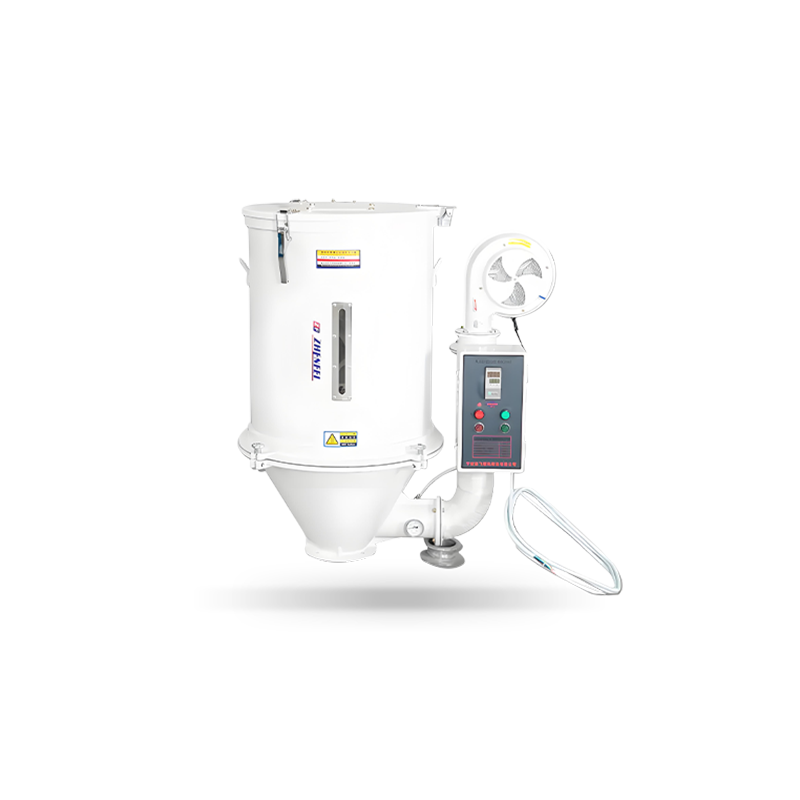
An SDF hopper dryer works by pulling ambient air through a heater and blower assembly, then pushing that heated, dehumidified air upward through a bed of plastic resin sitting in the hopper. As the resin moves down through the hopper toward the machine's feed throat, it spends a set amount of time exposed to hot airflow, which drives out surface and bound moisture before the material reaches the barrel.
Because drying happens as resin passes through the hopper, capacity isn't just about how much resin the hopper can physically hold — it's about how long each pellet spends inside relative to how fast your molding or extrusion machine is consuming material. A hopper that's too small for your throughput rate shortens residence time below what the resin needs, regardless of how hot the air is set.
Most hopper dryer manufacturers size equipment using a simple residence time formula:
Required Hopper Volume = Hourly Throughput (lbs/hr) × Required Drying Time (hrs) ÷ Bulk Density of Resin
For example, a production line consuming 100 lbs/hr of nylon that needs 4 hours of drying time would require a hopper sized to hold roughly 400 lbs of resin at any given moment, adjusted for the specific resin's bulk density.
| Resin Type | Drying Temperature | Typical Drying Time |
|---|---|---|
| ABS | 180–190°F (82–88°C) | 2–3 hours |
| Nylon (PA6/PA66) | 160–180°F (71–82°C) | 3–4 hours |
| Polycarbonate (PC) | 250°F (121°C) | 3–4 hours |
| PET | 300–320°F (149–160°C) | 4–6 hours |
| PP / PE (non-hygroscopic) | 150–160°F (66–71°C) | 1–2 hours (surface moisture only) |
Before selecting a hopper size, calculate your actual hourly consumption rate rather than estimating.
| Hopper Capacity | Suitable Throughput | Typical Application |
|---|---|---|
| 25–50 kg | Up to 15 kg/hr | Small injection molding machines |
| 100–200 kg | 25–50 kg/hr | Mid-size molding machines, single-line extrusion |
| 300–500 kg | 75–125 kg/hr | Large molding machines, multi-cavity tooling |
| 1,000 kg+ | 200 kg/hr+ | High-volume extrusion, central drying systems |
For highly hygroscopic resins, confirm the dryer can maintain a dew point of -40°F (-40°C) or lower at the hopper inlet, since inadequate dehumidification undermines even a correctly sized hopper.
Airflow (measured in CFM) must scale with hopper size — a larger hopper with underpowered airflow will develop cold spots and uneven drying despite having adequate total volume.
Choosing the right SDF hopper plastic dryer capacity means working backward from your actual hourly resin throughput and your specific resin's required drying time — typically 3 to 4 hours for common hygroscopic resins like nylon and PC — rather than picking a hopper size based on floor space or budget alone. Calculate your required volume using the throughput-times-drying-time formula, add a 15–20% buffer for production flexibility, and confirm the dryer's airflow and dew point performance scale appropriately with the hopper size to avoid the splay, bubbling, and inconsistent part quality that come from undersized drying capacity.

 Custom Zhenfei Electric Injection Molding Machine Manufacturers
Copyright © Ningbo Zhenfei Injection Molding Machine Manufacturing Co., Ltd. Rights Reserved.
Custom Zhenfei Electric Injection Molding Machine Manufacturers
Copyright © Ningbo Zhenfei Injection Molding Machine Manufacturing Co., Ltd. Rights Reserved.



 中文简体
中文简体 English
 Español
 中文简体
中文简体